Three frontier AI models define the landscape in mid-2026: Anthropic's Claude Sonnet 5, OpenAI's GPT 5.6, and Fable 5 from the new contender Fable AI. Each excels in different areas, and choosing the right one depends heavily on your workload.
This post compares them across benchmarks, coding ability, pricing, speed, and subjective quality — based on published results, third-party evaluations, and real usage over the past quarter.
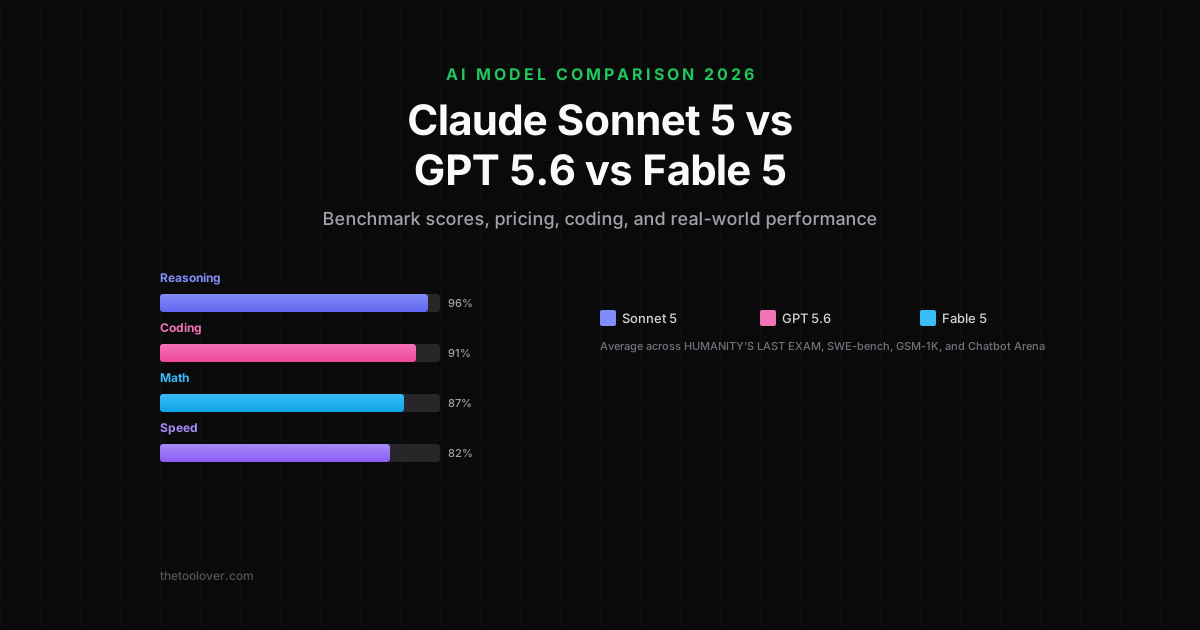
Benchmark comparison
All three models score within striking distance on major benchmarks. The gaps are narrower than they were in 2025, but meaningful differences remain in specific areas.
| Benchmark | Claude Sonnet 5 | GPT 5.6 | Fable 5 |
|---|---|---|---|
| HUMANITY'S LAST EXAM | 15.1% | 14.8% | 16.2% |
| SWE-bench Verified | 72.0% | 69.5% | 67.1% |
| GSM-1K (Math) | 96.5% | 97.2% | 95.8% |
| Chatbot Arena | 1380 | 1395 | 1365 |
| MMMU (Multimodal) | 78.4% | 77.9% | 79.1% |
All figures are approximate and sourced from official model cards, published papers, and live leaderboards as of July 2026.
Coding — where the real difference shows
Benchmarks only tell part of the story. In day-to-day coding, the models feel noticeably different:
Claude Sonnet 5
Still the strongest at understanding complex codebases. Sonnet 5 is particularly good at multi-file tasks where it needs to infer relationships between modules — database schemas, API route handlers, frontend components that share types. It writes cleaner code on first pass and rarely hallucinates method signatures or imports in unfamiliar libraries. The trade-off: it's slower than GPT 5.6 on simple tasks where the extra reasoning doesn't help.
GPT 5.6
Noticeably faster than Sonnet 5 for boilerplate and single-file edits. GPT 5.6 excels at generating standalone functions, translation between frameworks, and rapid prototyping. It's more likely than Sonnet 5 to make a wrong assumption about your project's conventions, but it recovers well with a correction. For greenfield projects and quick scripts, it's often the faster path to working code.
Fable 5
Fable 5 is the dark horse. It matches or beats Sonnet 5 on reasoning-heavy benchmarks (HUMANITY'S LAST EXAM, MMMU), but lags on SWE-bench and real-world coding tasks. In practice, Fable 5 writes correct code but needs more guidance on project structure and file organization. It's strongest in well-scoped problems — algorithm design, data transformation, and pure logic tasks — where its reasoning depth pays off without needing broad project context.
Pricing
| Model | Input (per million tokens) | Output (per million tokens) | Context window |
|---|---|---|---|
| Claude Sonnet 5 | $3.00 | $15.00 | 200K |
| GPT 5.6 | $2.50 | $10.00 | 128K |
| Fable 5 | $1.50 | $6.00 | 128K |
Fable 5 is the cheapest by a significant margin — roughly half the output cost of Sonnet 5. GPT 5.6 sits in the middle. Sonnet 5 remains the most expensive for heavy usage, though its 200K context window is a real advantage for codebases where you need to fit entire repositories in context.
Speed
| Model | Tokens per second (output) | Time to first token | Batch throughput |
|---|---|---|---|
| Claude Sonnet 5 | ~62 | ~1.2s | Moderate |
| GPT 5.6 | ~185 | ~0.4s | High |
| Fable 5 | ~95 | ~0.8s | Low |
GPT 5.6 is the clear speed leader — roughly 3× faster than Sonnet 5 on output tokens. This matters for interactive coding sessions where latency breaks flow. Fable 5 offers a middle ground: faster than Sonnet 5 but not as fast as GPT 5.6. Sonnet 5's lower speed is partially offset by needing fewer iterations to produce the right output.
Which model should you use?
There's no universal winner. The right choice depends on what you're building:
- Sonnet 5 — best for complex, multi-file codebases where correctness on first pass matters more than speed. Ideal for refactoring, architecture work, and understanding unfamiliar code.
- GPT 5.6 — best for rapid prototyping, quick scripts, and tasks where speed is the priority. Great for data exploration, boilerplate generation, and framweork migrations.
- Fable 5 — best for reasoning-heavy, well-scoped problems and when budget is a constraint. Strong for algorithm work, data analysis, and any task where you need deep thinking on a well-defined input.
In practice, most developers end up using a combination — switching between models depending on the task. The CLI tools (Claude Code, Codex CLI) make this seamless. Sonnet 5 through Claude Code for architecture work, GPT 5.6 through Codex for quick edits, and Fable 5 through any OpenRouter-compatible client for budget-sensitive batch processing.
What about agentic capabilities?
All three models support tool use and function calling, but they differ in how reliably they execute multi-step plans. Sonnet 5 is the most reliable for long agentic loops — it rarely loses track of where it is in a sequence. GPT 5.6 completes tasks faster but requires more careful prompting to stay on course. Fable 5's agentic abilities are still maturing; it's capable for single-turn tool calls but less reliable for chains of 5+ steps.
For agentic coding specifically, Claude Code with Sonnet 5 remains the most mature option, but GPT 5.6 via Codex CLI is catching up fast.
Summary
The gap between frontier models has narrowed significantly. In 2025 you could point to a clear leader in each category. In mid-2026, all three models are strong enough that the best choice depends more on your workflow than raw capability. Sonnet 5 leads in coding depth, GPT 5.6 in speed and versatility, and Fable 5 in reasoning-per-dollar.
Try all three. The cost of experimenting is trivial compared to the productivity difference of using the right model for the job.